

GCTU Developing Policy Recommendations on Social Protection for Older Workers
The General Confederation of Trade Unions (GCTU) is developing a set of recommendations aimed at promoting active working longevity and providing additional social protection for older workers. These goals are outlined in the draft document “Key Directions of Social Policy Concerning Older Workers.”
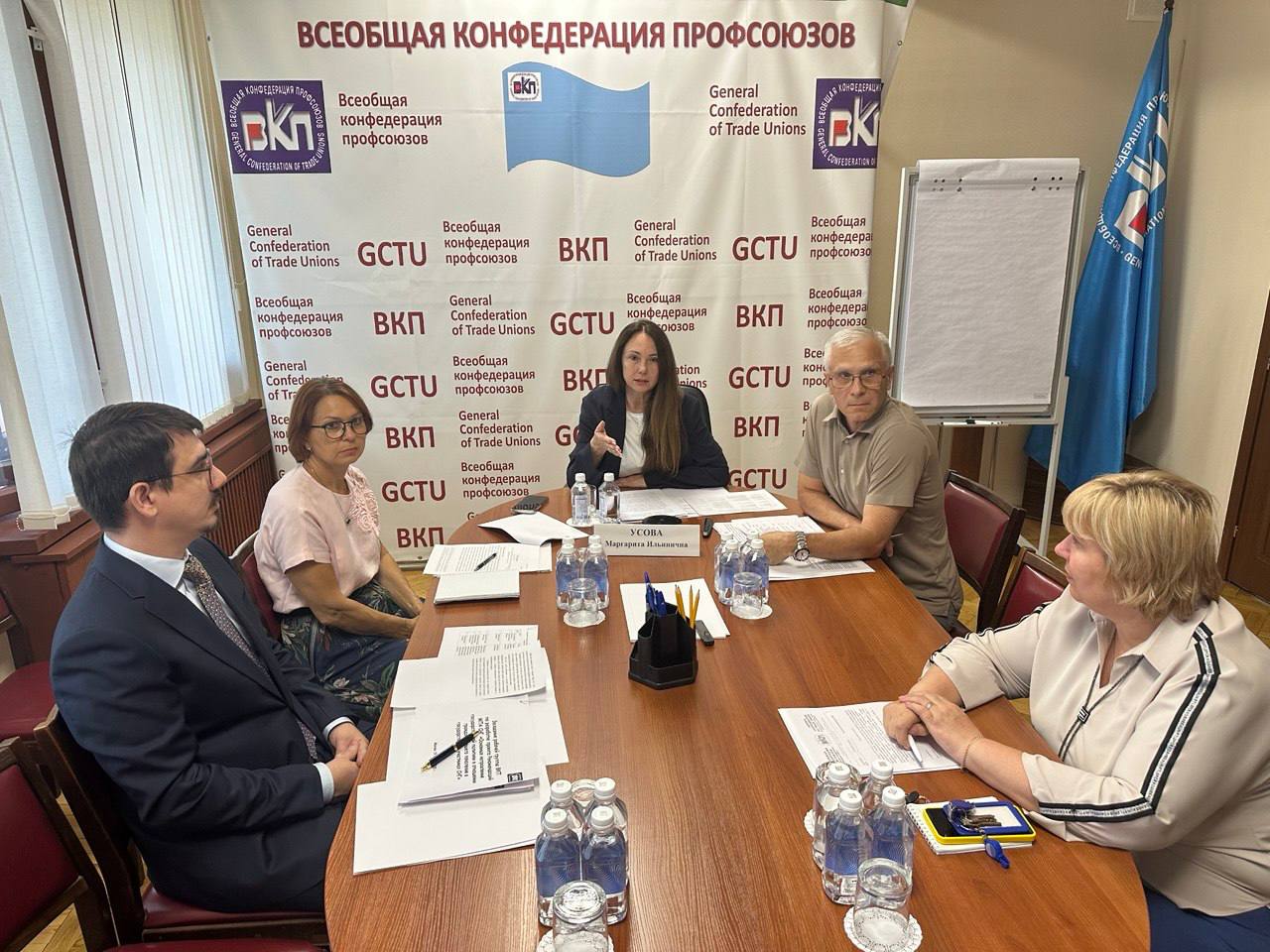
The draft is being prepared by a GCTU working group comprising subject-matter experts, trade union leaders, and representatives of member organizations. The latest meeting of the group took place at the GCTU headquarters on July 29.
The event brought together representatives of national trade union centers from six CIS countries and eight international sectoral trade union organizations.
“We are witnessing a global shift in employment structures. The number of older individuals remaining in the workforce is growing. Trade unions have observed that older workers require targeted social protection measures that reflect their specific needs. For trade unions, it is a timely and important task to develop recommendations that will enable all parties of social partnership to implement effective social policies that respond to current demographic trends and labor market changes,” said Margarita Usova, GCTU Deputy General Secretary, opening the meeting.
During the session, the group established a common approach to drafting the recommendations. According to the draft, regulation should focus on supporting active working longevity for older employees, based on the principles of intergenerational solidarity and the elimination of all forms of age discrimination.
Tatyana Shestakova, a representative of the International Union of Public Service Workers, noted that in some sectors there is a visible outflow of older workers, while younger workers are not filling these positions, resulting in staff shortages.
Although unions are striving to retain experienced personnel, older workers do not always have access to the necessary guarantees, such as protection from redundancy.
Shestakova emphasized the importance and timeliness of developing recommendations to enhance social guarantees for senior employees.
Her position was supported by Jamshed Yunusov, Head of the Socio-Economic Department of the Federation of Independent Trade Unions of Tajikistan.
“The GCTU’s work on developing these recommendations is highly relevant.The skills shortage and the need to transfer production experience are systemic issues.Senior workers, many of whom were trained during the Soviet period, possess valuable experience.This category of workers remains in demand on the labor market, but they require proper social protection and should be engaged as mentors,”he stated.
The draft notes that this policy shift is occurring against the backdrop of changing societal attitudes toward older generations. The increase in life expectancy is placing greater pressure on social policy systems, while older people are becoming primary consumers of social services. This sector is expanding, as is the share of skilled older workers.
The draft recommendations outline key priorities in social policy, including:
• Occupational health and safety,
• Employment guarantees,
• Opportunities for upskilling and reskilling,
• Provision of social services at the workplace.
“In the Commonwealth countries’ healthcare systems, active working longevity is particularly important.
It is often older healthcare professionals who take on mentoring roles, pass on their knowledge, and maintain team cohesion. We advocate an approach in which the experience of older generations is seen as a developmental asset, not a source of vulnerability. We must create conditions that make older professionals feel protected and included in public life,”. emphasized Olga Zhankevich, General Secretary of the International Confederation of Health Workers’ Trade Unions.
The draft was broadly supported by the Federation of Trade Unions of Belarus, whose representatives emphasized the importance of clearly identifying all stakeholders and agencies to whom the recommendations will be addressed if adopted by the CIS Interparliamentary Assembly. Marina Lazar, Head of the Legal Department of the FTUB, proposed that the current draft be adopted as a working basis.
The revised draft, incorporating suggestions and amendments from the meeting, will now be circulated to GCTU member organizations for review.
It will form the foundation for the next stage of expert work, which is expected to be completed by October 1, the International Day of Older Persons.
GCTU News
-
President of Russia Vladimir Putin Presents the Order of Honour to Viktor Pinsky
Viktor Pinsky, a member of the Russian State Duma and General Secretary of the General Confederation of Trade Unions (GCTU), has been awarded the Order of Honour. The award was presented by Vladimir Putin, President of the Russian Federation.
"My sincere congratulations! I am glad that your work has been duly recognised by the country's leadership," Vladimir Putin said as he presented the award to Viktor Pinsky.
The ceremony took place today in the St George's Hall of the Kremlin in Moscow.
-
Margarita Usova presents GCTU initiatives at the “Trade Unions. 21st Century” forum
On October 8, Sochi is hosting the 8th All-Russian Intelligence Forum “Trade Unions. 21st Century. An Era of Change.” For the third year running, the General Confederation of Trade Unions is the forum's general partner.
-
GCTU takes part in EEC Advisory Committee meeting on social security for workers
On October 8, Moscow hosted the ninth meeting of the Advisory Committee on Social Security, Pension Rights, Medical Care, and Professional Activities of Workers of the Eurasian Economic Union (EAEU) member states, held at the Eurasian Economic Commission (EEC).