

Decent wages, labour protection, digitalization: current tasks of trade unions discussed at the FNPR General Council
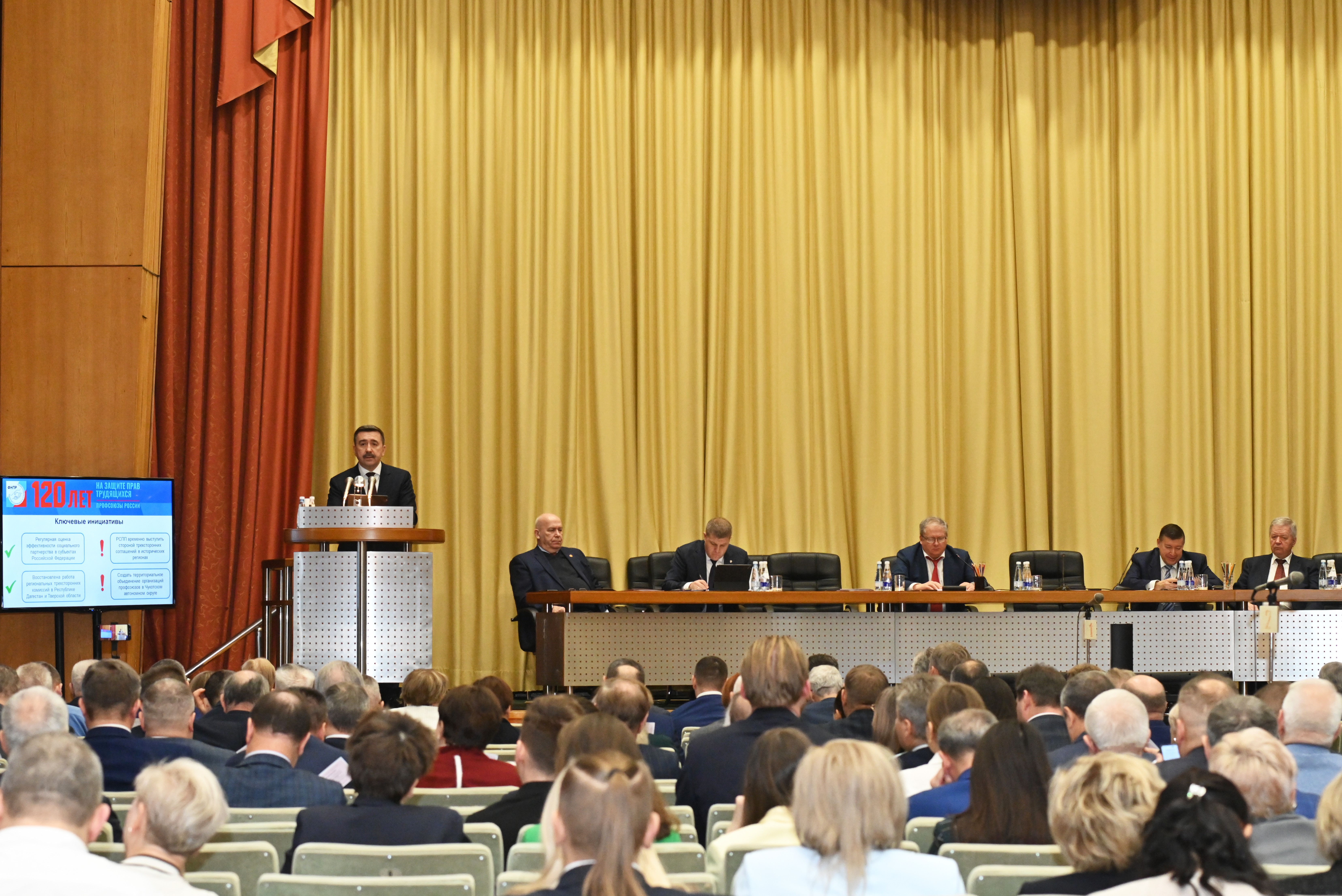
In the program report “On the Activities of the FNPR and the Tasks of Trade Unions at the Present Stage”, Federation Chairman Sergey Chernogaev assessed the current economic situation. He pointed to the slowdown in the growth of the Russian economy due to tight monetary policy. He drew attention to the growing risks for the labour market, including a reduction in the number of vacancies and an increase in wage arrears.
The main topic of the report was the FNPR Program “For a Fair Economy”, which defines strategic goals. Sergey Chernogaev identified several priority areas of work. This is a decent wage. The FNPR intends to raise the minimum wage to the level of the minimum consumer budget, which, according to the Federation’s calculations, should amount to at least 59,625 rubles in 2025. In addition, trade unions plan to protect the rights of new categories of workers, in particular, to seek the extension of basic social and labor guarantees to platform-based employees. Another priority is to strengthen labour protection control.
The FNPR intends to counteract the weakening of state supervision in the labour field, improve trade union control based on a risk‑oriented model, and seek tougher responsibility for concealing accidents. Another area is the development of social partnership. The Federation plans to legislatively consolidate the mechanisms for implementing the constitutional guarantee of social partnership and strengthen the role of sectoral agreements.
In 2026, the FNPR will have to actively participate in collective negotiations to conclude a new general agreement and seek to include trade union initiatives in its text, Sergey Chernogaev said.
In addition, the FNPR General Council discussed the need for digital transformation of trade unions and the creation of an IT-platform for the provision of personal services. It was decided at the meeting to form a permanent commission of the FNPR General Council for the support of participants and veterans of a special military operation, as well as their family members. The Commission will be headed by Sergey Nekrasov, FNPR Deputy Chairman.
At the suggestion of Sergey Chernogaev, Anton Doroshev was elected the new Deputy Chairman of the Federation. He will be responsible for digitalizing the work of trade unions.
GCTU News
-
President of Russia Vladimir Putin Presents the Order of Honour to Viktor Pinsky
Viktor Pinsky, a member of the Russian State Duma and General Secretary of the General Confederation of Trade Unions (GCTU), has been awarded the Order of Honour. The award was presented by Vladimir Putin, President of the Russian Federation.
"My sincere congratulations! I am glad that your work has been duly recognised by the country's leadership," Vladimir Putin said as he presented the award to Viktor Pinsky.
The ceremony took place today in the St George's Hall of the Kremlin in Moscow.
-
Margarita Usova presents GCTU initiatives at the “Trade Unions. 21st Century” forum
On October 8, Sochi is hosting the 8th All-Russian Intelligence Forum “Trade Unions. 21st Century. An Era of Change.” For the third year running, the General Confederation of Trade Unions is the forum's general partner.
-
GCTU takes part in EEC Advisory Committee meeting on social security for workers
On October 8, Moscow hosted the ninth meeting of the Advisory Committee on Social Security, Pension Rights, Medical Care, and Professional Activities of Workers of the Eurasian Economic Union (EAEU) member states, held at the Eurasian Economic Commission (EEC).