

Viktor Pinsky on Occupational Safety and Health: “A Priority of National Importance”
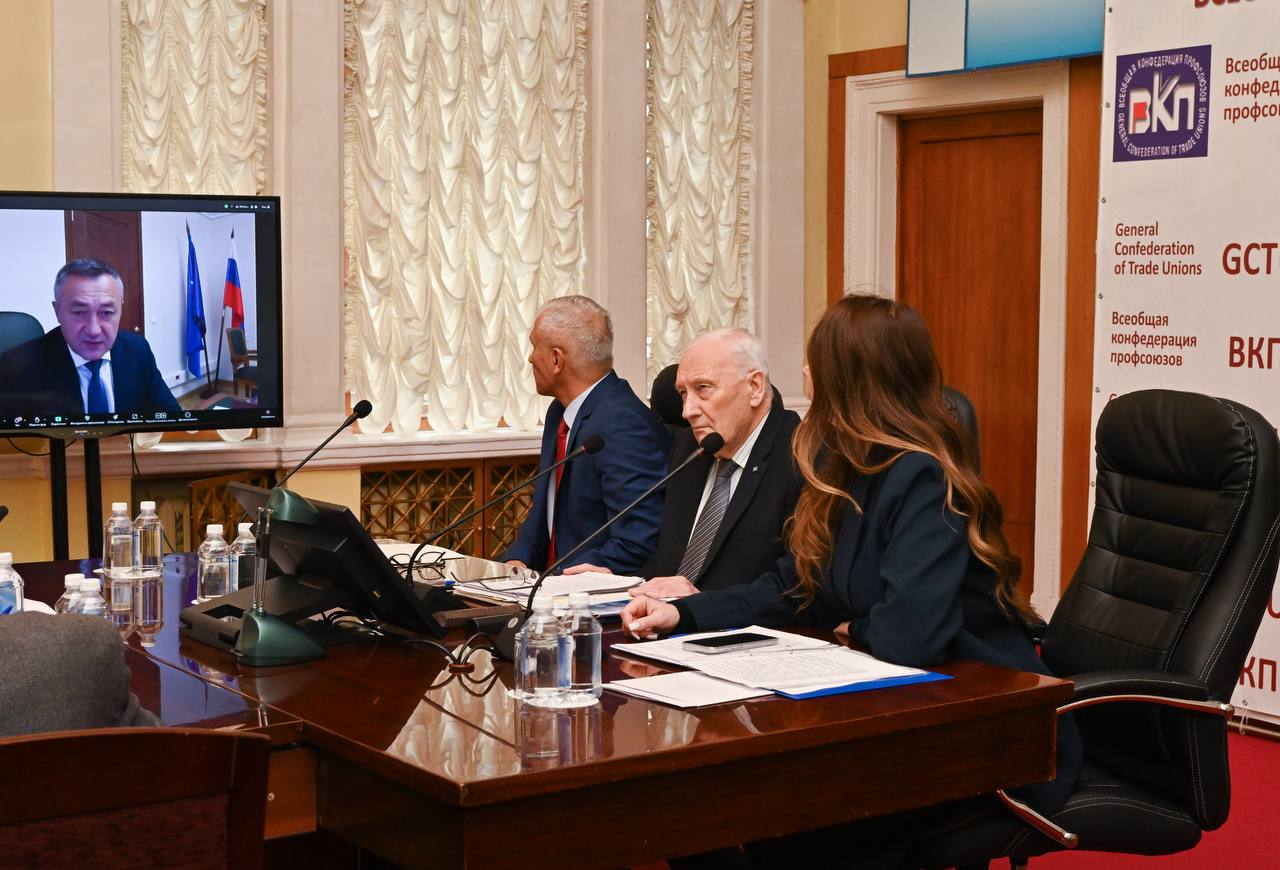
More than 200 participants of the educational program for technical labour inspectors from GCTU member organizations observed the Commission’s work.
The main point of the meeting was to assess the potential for implementing a risk-based approach to occupational safety and health in the countries of the Commonwealth of Independent States (CIS). The risk-based model represents a shift in occupational safety management from a reactive approach, wh ere action is taken only in response to incidents, to a proactive one aimed at anticipating and identifying potential hazards and risks before they result in workplace accidents or injuries.
“Occupational safety and health is a priority of national importance for every state. A risk-based approach in this area encourages employers to improve working conditions and ensure employee safety. It reduces the likelihood of occupational diseases and workplace accidents for workers, while also lowering costs for employers. The safer the workplace, the lower the contribution rates to social insurance funds. This is the key difference from the traditional, cost-heavy, compensation-based model of occupational safety,” Pinsky noted.
The GCTU Secretary-General emphasized that the role of trade union labour inspections becomes increasingly important in the transition to this new model of occupational safety and health. Such a transition, he noted, is only possible through the joint efforts of all three sides of social partnership.
In today’s environment of growing global competition, governments are often compelled to ease state oversight, including in the area of occupational safety. This makes it crucial to maintain a balance of interests among the social partners in this field. It is unacceptable, Pinsky stressed, for trade union inspectors to carry out — without compensation — functions equivalent to those of state labour inspectorates, while being denied access to relevant information systems.
To address this issue, he called for more active use of social partnership mechanisms, including tripartite agreements and direct cooperation between trade unions, state labour inspectorates, and social insurance funds.
A report on the trade unions’ position regarding the introduction of occupational risk management systems in CIS countries — taking into account workplace conditions and workers’ health assessments — was presented by Mikhail Ganichev, Head of the GCTU Department for Occupational Safety, Environment, Health, and Social Protection of Workers.
Nodira Gaibnazarova, Head of the Occupational Safety Department of the Federation of Trade Unions of Uzbekistan, spoke about the role of trade unions in improving working conditions in the Republic of Uzbekistan.
Alexey Bezyukov, Secretary of the Federation of Independent Trade Unions of Russia (FNPR) and Head of its Department for Occupational Safety and Environment — Chief Technical Labour Inspector of the FNPR — discussed the development of occupational risk management systems in the Russian Federation.
Yury Guznaev, Chief Technical Labour Inspector of the Trade Union of Healthcare Workers of the Russian Federation, highlighted the role of the union in protecting the labor rights of healthcare employees in the field of occupational safety.
Ilya Udovenko, Deputy Head of the GCTU Department, presented the GCTU’s educational project and its program “Promising Directions for the Activity and Development of Trade Union Technical Labour Inspections”.
The project aims to create an international educational space for trade unions by pooling the resources of the scientific and educational institutions within the Confederation’s member organizations. Training is carried out in four key areas: occupational safety and workers’ health, social policy and social partnership, international humanitarian cooperation, and trade union development.
Participants who successfully complete the final assessment will receive GCTU certificates.
GCTU News
-
President of Russia Vladimir Putin Presents the Order of Honour to Viktor Pinsky
Viktor Pinsky, a member of the Russian State Duma and General Secretary of the General Confederation of Trade Unions (GCTU), has been awarded the Order of Honour. The award was presented by Vladimir Putin, President of the Russian Federation.
"My sincere congratulations! I am glad that your work has been duly recognised by the country's leadership," Vladimir Putin said as he presented the award to Viktor Pinsky.
The ceremony took place today in the St George's Hall of the Kremlin in Moscow.
-
Margarita Usova presents GCTU initiatives at the “Trade Unions. 21st Century” forum
On October 8, Sochi is hosting the 8th All-Russian Intelligence Forum “Trade Unions. 21st Century. An Era of Change.” For the third year running, the General Confederation of Trade Unions is the forum's general partner.
-
GCTU takes part in EEC Advisory Committee meeting on social security for workers
On October 8, Moscow hosted the ninth meeting of the Advisory Committee on Social Security, Pension Rights, Medical Care, and Professional Activities of Workers of the Eurasian Economic Union (EAEU) member states, held at the Eurasian Economic Commission (EEC).