

General Confederation of Trade Unions Calls for the Protection of Platform Workers’ Rights
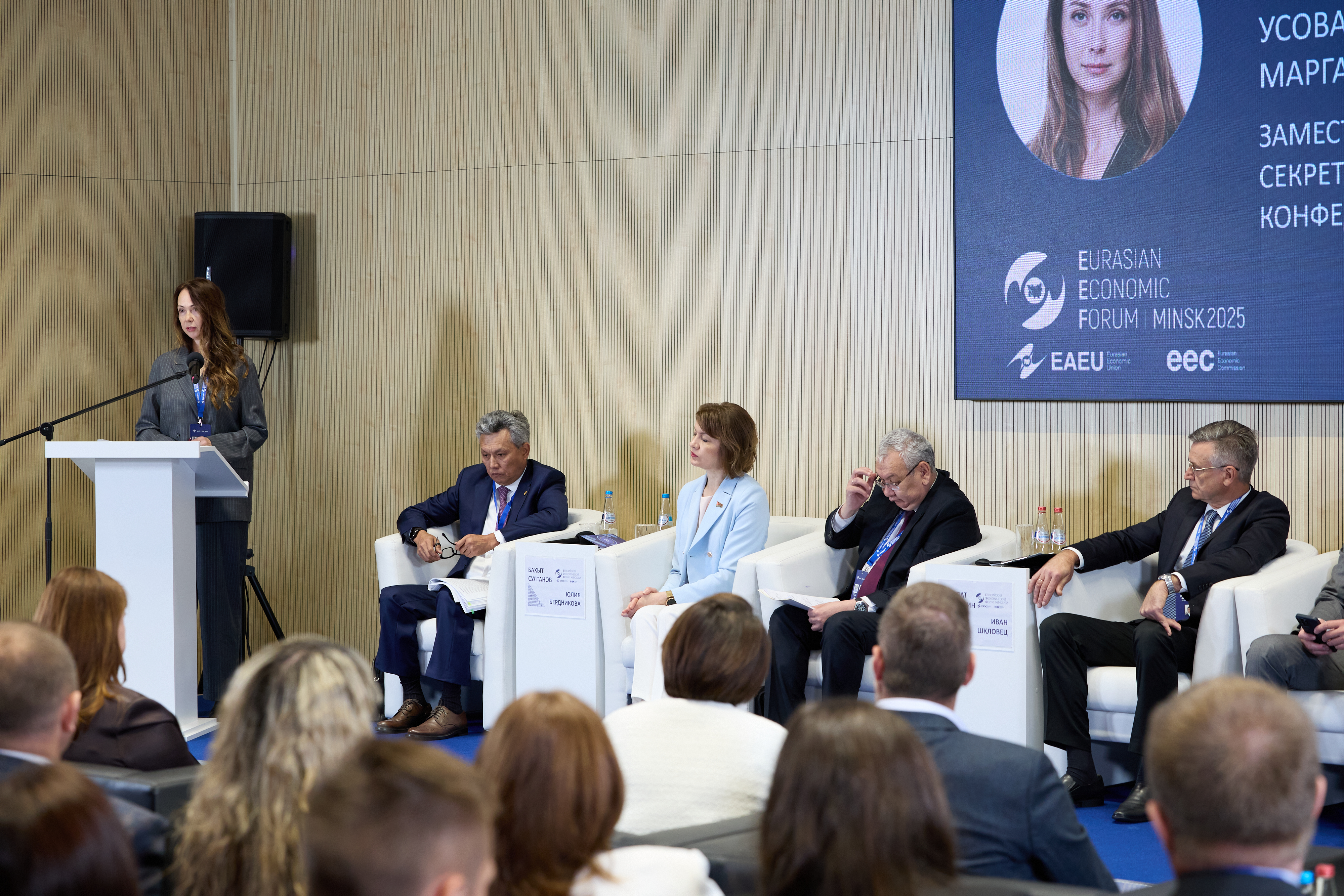
Margarita Usova, Deputy General Secretary of the General Confederation of Trade Unions (GCTU), called for enhanced social protection for platform workers during the plenary session “Single Labour Market: Challenges and Prospects” at the Eurasian Economic Forum held in Minsk.
“Technological progress gives rise to new business models and creates non-standard forms of employment such as self-employment and platform-based work.
Trade unions believe that the labor rights and social protections of digital platform workers are currently insufficiently safeguarded. In most CIS countries, non-standard forms of employment remain largely unregulated by law,”- Usova said in her address.
Trade unions, she noted, are consistently working to defend the rights of workers — including those engaged in what is referred to as the digital economy, of which platform-based employment is an integral part.
“Within the CIS, work is currently underway on a draft Model Law on Platform Employment, in which the GCTU is actively involved. We are advocating for provisions that protect the rights and interests of workers engaged via platforms,” - emphasized the Deputy General Secretary.
The draft law incorporates proposals submitted by the GCTU, including:
• protection of platform workers’ rights,
• a ban on civil-law contracts in hazardous occupations,
• mechanisms for collective protection and social partnership.
Particular attention is given to dispute resolution procedures, employment of foreign citizens, compliance with migration legislation, and cross-border considerations.
The draft also reflects the GCTU’s proposal to ensure that individuals have the right to appeal automated fines imposed by digital platforms.
In her speech, Usova emphasized the importance of harmonizing approaches to regulating non-standard and platform-based employment across the CIS and facilitating the exchange of legislative initiatives in this area. According to her, such coordination is essential to building a unified labour market within the CIS.
The General Confederation of Trade Unions was represented at the forum by Margarita Usova, Deputy General Secretary, and Aleksandra Balenko, Head of the GCTU Department for the Protection of Workers’ Socio-Economic Interests.
GCTU News
-
President of Russia Vladimir Putin Presents the Order of Honour to Viktor Pinsky
Viktor Pinsky, a member of the Russian State Duma and General Secretary of the General Confederation of Trade Unions (GCTU), has been awarded the Order of Honour. The award was presented by Vladimir Putin, President of the Russian Federation.
"My sincere congratulations! I am glad that your work has been duly recognised by the country's leadership," Vladimir Putin said as he presented the award to Viktor Pinsky.
The ceremony took place today in the St George's Hall of the Kremlin in Moscow.
-
Margarita Usova presents GCTU initiatives at the “Trade Unions. 21st Century” forum
On October 8, Sochi is hosting the 8th All-Russian Intelligence Forum “Trade Unions. 21st Century. An Era of Change.” For the third year running, the General Confederation of Trade Unions is the forum's general partner.
-
GCTU takes part in EEC Advisory Committee meeting on social security for workers
On October 8, Moscow hosted the ninth meeting of the Advisory Committee on Social Security, Pension Rights, Medical Care, and Professional Activities of Workers of the Eurasian Economic Union (EAEU) member states, held at the Eurasian Economic Commission (EEC).