

Social Partnership and New Forms of Employment Discussed by Russian and Belarusian Trade Unions in Minsk
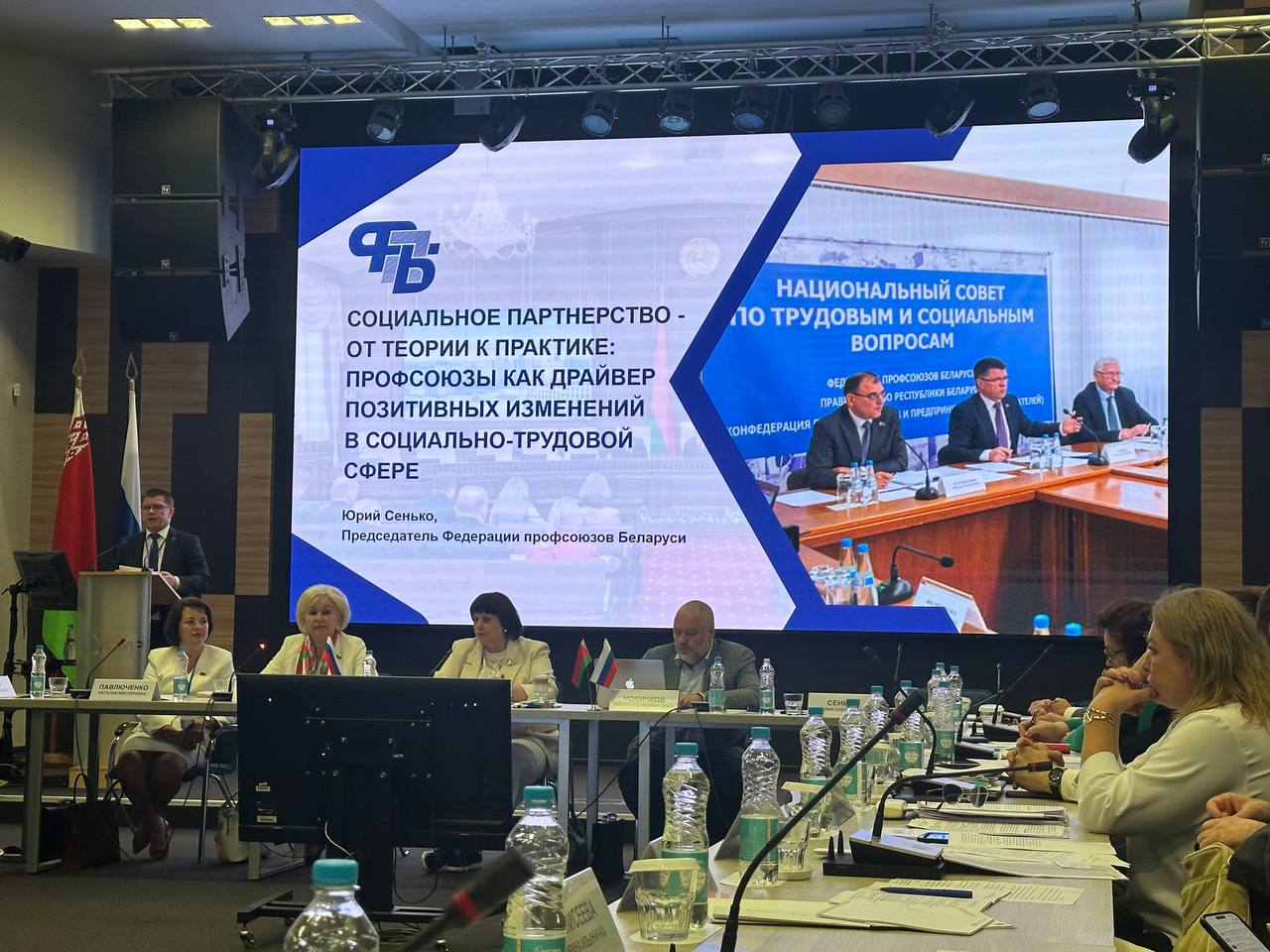
The development of the regulatory and legal framework, the creation of a unified legal information system, and other integration processes became key topics of discussion at the Standing Seminar of the Parliamentary Assembly of the Union of Belarus and Russia on the Construction of the Union State, held on July 10–11 in Minsk. This marks the 80th session of the seminar.
“An analysis and comparison of international experience shows that without a systemic social dialogue, it is impossible to ensure the continuous improvement of legislation and practical approaches in the social and labor sphere. The proposals put forward by trade unions regarding the development of labor legislation are based on the practice of collective bargaining and contractual regulation,” said Yuri Senko, Chairman of the Federation of Trade Unions of Belarus, in his address.
In his speech, the trade union leader emphasized the importance of understanding that agreements at various levels and the overall system of social partnership also contribute to addressing the challenges faced by employers, the social and labor sphere, and the state as a whole.
He highlighted the active role of trade unions in the legislative process, noting that representatives of the Federation of Trade Unions are members of the working group on amendments to the Labour Code, promote the concept of mentorship, and advocate for its formal recognition at the legislative level.
Significant attention during the session was devoted to issues of the platform economy and new and non-standard forms of employment. The level of worker involvement in the platform economy differs between Russia and Belarus, yet trade unions in both countries recognize the importance of these developments for their members and for the labor market as a whole.
“We understand the need to look ahead. That is why we are studying the experience of our international colleagues.
In particular, in May of this year, the platform economy and its impact on the labor market were discussed at the Forum of Trade Union Leaders of the Shanghai Cooperation Organization Countries, which took place in Beijing.
There is an agreement to explore China’s experience in more depth, and we are working on this today in cooperation with our International Trade Union University ‘MITSO’,” Yuri Senko noted.
GCTU News
-
Viktor Pinsky: "The meeting of the General Confederation of Trade Unions Council in Dushanbe is a landmark event for the entire trade union movement of the Commonwealth of Independent States"
Dushanbe, Tajikistan, July 1, 2026 – Viktor Pinsky, Chairman of the Commission of the Russian State Duma on Regulations and Organisation of State Duma Activities and General Secretary of the General Confederation of Trade Unions (GCTU), called the meeting of the GCTU Council, held on July 1 in Dushanbe, a landmark event for the trade unions of the Commonwealth of Independent States.
-
Viktor Pinsky Met with Deputies of the Parliament of Tajikistan
June 30, Dushanbe, Tajikistan – The work on developing model labor legislation within the CIS format was discussed during a meeting between Viktor Pinsky, Chairman of the Commission of the Russian State Duma on Regulations and Organisation of State Duma Activities and General Secretary of the General Confederation of Trade Unions (GCTU), and Makhmadshokh Gulzoda, Chairman of the Committee on International Affairs, Public Associations, and Information of the Majlisi Namoyandagon Majlisi Oli of the Republic of Tajikistan. The meeting, held today in Dushanbe at the Parliament of Tajikistan, was also attended by other deputies of the Tajik Parliament: Orip Amirsoda, Chairman of the Environmental Commission; Naima Solizoda, member of the Commission on Deputy Ethics; Karakhon Chillazoda, Chairman of the Federation of Independent Trade Unions of Tajikistan; and Margarita Usova, Deputy General Secretary of the GCTU.
-
Viktor Pinsky met with the Deputy Minister of Labor of Tajikistan
June 30, Dushanbe, Tajikistan - The gradual formation of a common labour market and the regulation of labour migration among the member states of the Commonwealth of Independent States were the main topics of a meeting between the Chair of the Commission on Rules and Maintenance of Activity of the State Duma, and the General Secretary of the General Confederation of Trade Unions (GCTU), and Sharif Norzoda, Deputy Minister of Labour, Migration and Employment of the Republic of Tajikistan.